
From Classification to Conversation: Event Registry and NewsAPI.ai Product Updates
From broader source coverage and multilingual classification to a hosted NewsAPI.ai MCP and a faster Event Registry platform, ER Pulse #5 explores the capabilities available today—and the AI-powered news intelligence now in development.


How broader coverage, stronger news understanding and new AI integrations are expanding what our products can do.
News intelligence depends on more than collecting articles. It requires broad and reliable coverage, the ability to understand information across languages, and practical tools for turning that information into useful insights.
This year, we strengthened each of those layers.
Event Registry and NewsAPI.ai share the same news-intelligence foundation, but they serve different ways of working. Event Registry provides a visual environment for exploring, monitoring and analysing news. NewsAPI.ai gives developers, applications and AI tools programmatic access to structured news data.
Across both products, our focus has been the same: improve the quality of the underlying data, deepen our understanding of news and make those capabilities easier to use.
Available Now
The developments already in production fall into four connected areas.
1. Data and Coverage: More Control Over the Information Entering the System
Good analysis starts with the right sources. We have therefore expanded both the range of information available and the controls for selecting it.
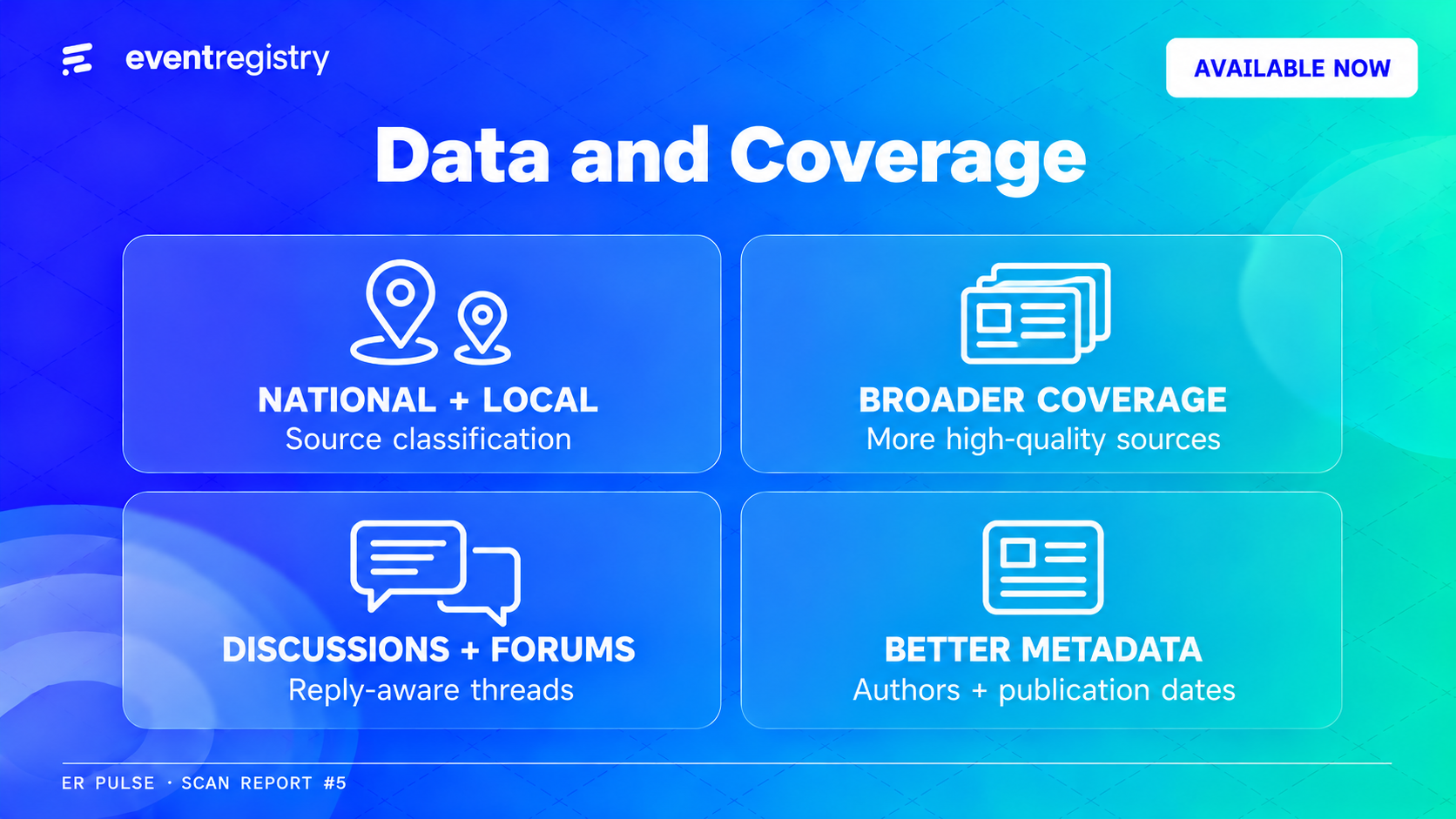
News sources are now automatically classified as either national or local. This gives users more precise control when filtering the feed, whether they are following a country-wide story or looking for reporting rooted in a particular community. We explored the importance of these distinctions in our article about filtering news sources by geography and reach.
We also added more high-quality sources to broaden the overall coverage available through our products.
Alongside traditional news publishing, discussion and forum content has been introduced as a distinct data source. Reply threading preserves the structure of conversations, making it possible to understand not only what was posted but also how a discussion developed.
Several less visible metadata improvements support this expanded coverage. Author extraction and publication-date parsing have been improved, while fixes to author search make it easier to find reporting from specific journalists or contributors.
Together, these changes provide a stronger and more flexible starting point for monitoring and analysis.
2. News Understanding: From Topics to Events
Collecting more information is valuable only if the system can understand and organise it effectively.
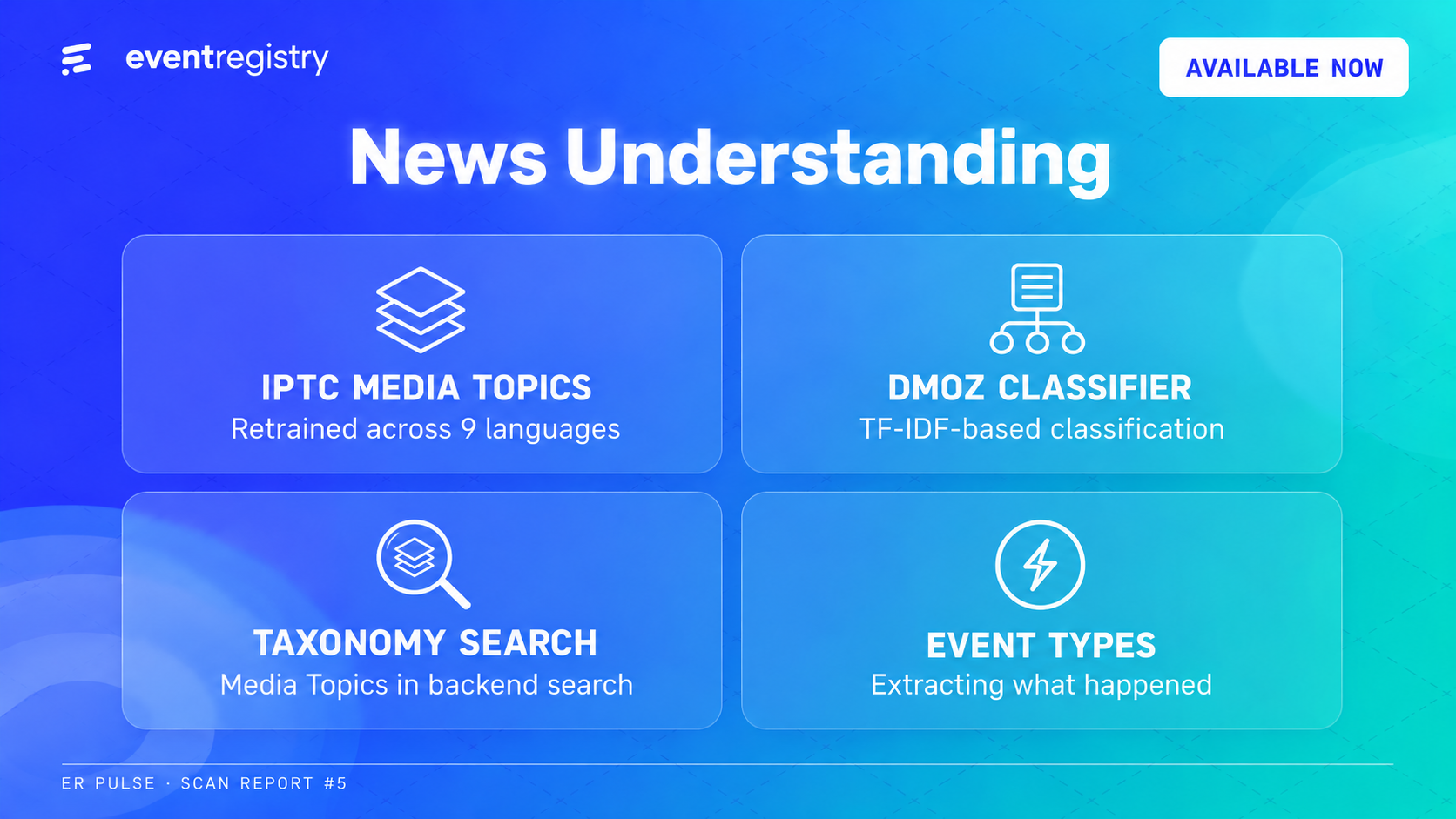
Our classifiers based on the IPTC Media Topics taxonomy have been retrained across nine languages, with particularly significant improvements for languages using non-Latin scripts. English and multilingual models are now live, while temperature-scaled cosine weighting produces a more useful spread of topic probabilities instead of allowing a single classification to dominate every result. More detail about the taxonomy and its use in news datasets is available in our article on IPTC Media Topics and multilingual news datasets.
Classification has also expanded through a TF‑IDF-based DMOZ classifier. It is available through the Classification API and now runs directly in the production newsfeed, removing the previous dependency on a separate analytics service.
At the same time, we completed the transition to the rebuilt newsfeed. IPTC Media Topics labels are applied during article processing and can now be used in backend search, creating a closer connection between how content is classified and how users can retrieve it.
Topic classification tells us what an article is about. Event Types help identify what actually happened.
Event Type extraction is now part of the article-processing backend, supported by updated named-entity recognition, coreference and relation-extraction components. This adds another layer of structure by distinguishing specific developments within the wider news flow. Our earlier article on Event Types as real-time signals explains how this approach helps move from broad topics towards identifiable developments.
The result is a stronger news-understanding layer: one that can organise coverage by subject, language and the type of development being reported.
3. Event Registry Platform: A Faster, Clearer Analysis Experience
Within Event Registry, these intelligence capabilities become part of a visual environment for searching, exploring and monitoring global news.
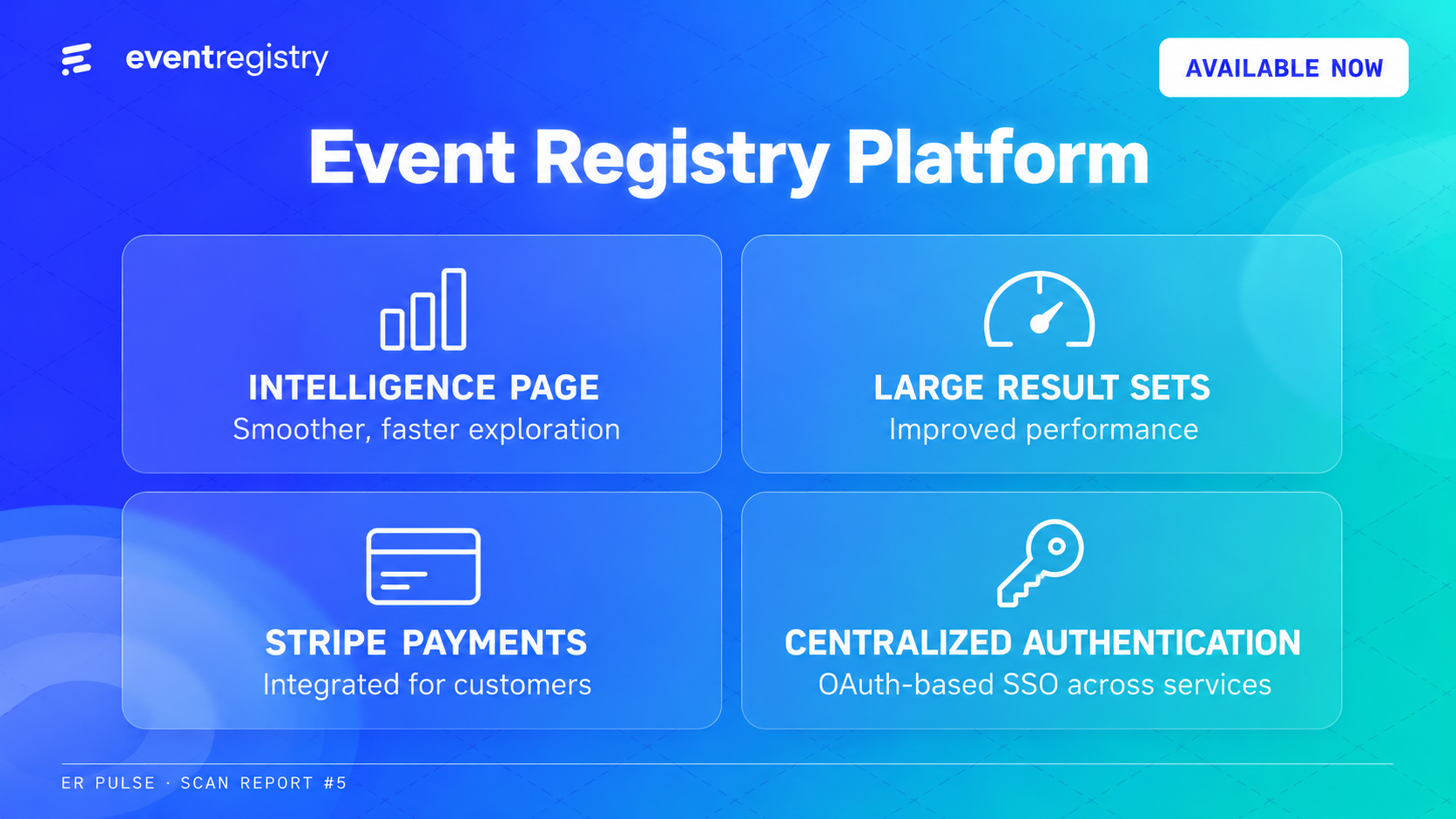
The Intelligence page has been substantially reworked. Visualisations are smoother, interactions are more reliable and performance has been improved when working with large result sets. These changes make it easier to move between the wider picture and the individual articles or developments behind it.
The rebuilt newsfeed and new taxonomy processing also strengthen the platform beneath the interface. More consistent classification and improved search capabilities give users a better foundation for defining what they want to follow.
These are meaningful steps forward for the current Event Registry experience. They are also the foundation for the much broader platform and UX work described later in this report.
4. NewsAPI.ai: Structured News for APIs and AI Workflows
NewsAPI.ai provides access to structured news intelligence for developers, applications and automated workflows. This year, that access has also expanded into a new generation of AI tools.
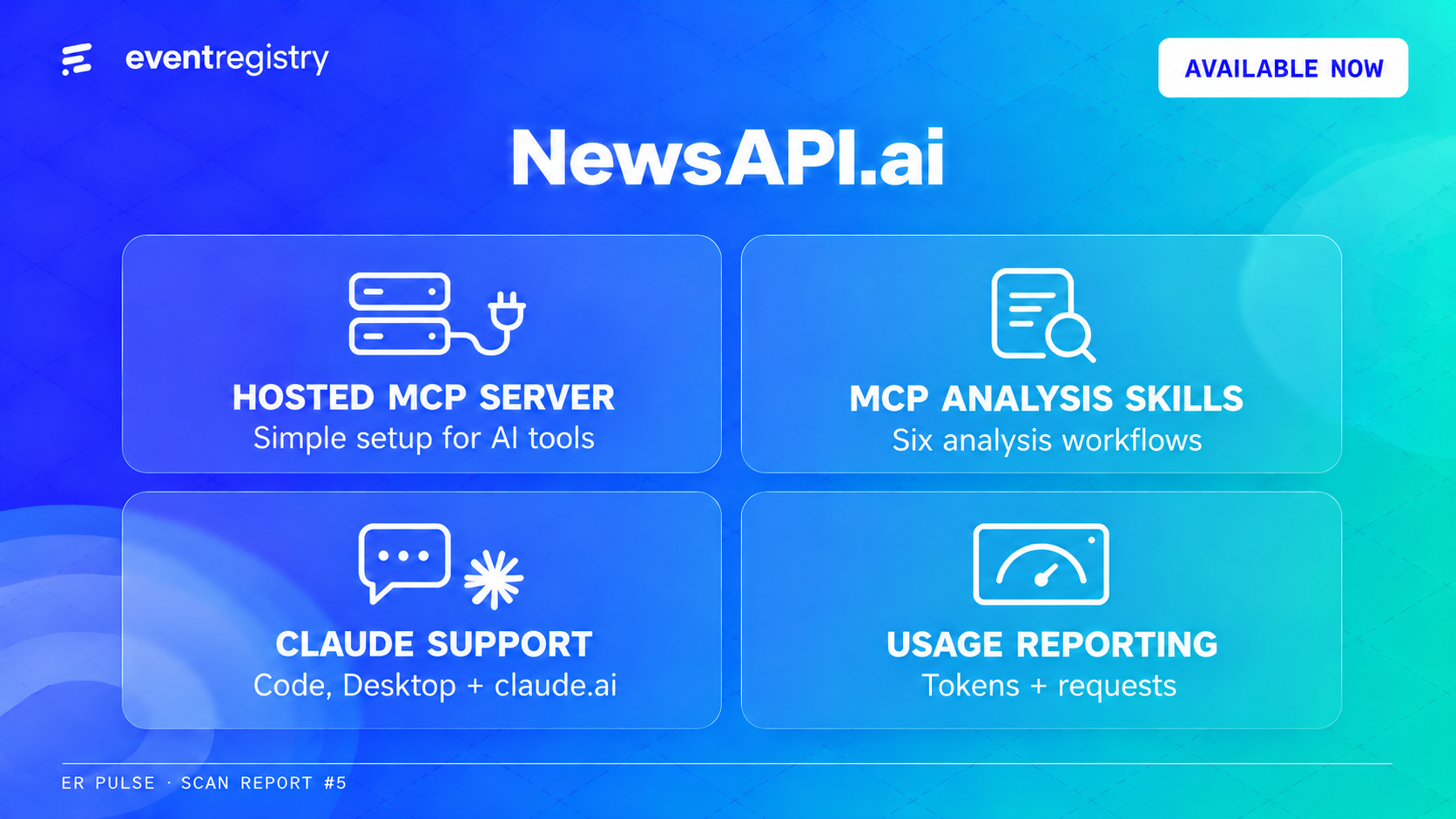
The NewsAPI.ai MCP server connects NewsAPI.ai with compatible AI assistants through the Model Context Protocol. It enables AI tools to search structured news, examine articles and events, create research reports and build timelines using NewsAPI.ai data.
The MCP originally became available as a local npm package. A hosted MCP server is now also available at https://mcp.newsapi.ai/mcp, making setup considerably easier. Users can add the server address to a compatible AI tool and connect through their Event Registry account without having to run the server locally.
The MCP has also been extended with six specialised research skills:
- News overviews
- Due diligence
- Risk
- Markets
- Political analysis
- Source analysis
In Claude Code, the hosted MCP server and all six skills can be installed together through a plugin. For Claude Desktop and claude.ai, the skills are available as individual ZIP files through the NewsAPI.ai MCP GitHub releases.
These specialised skills give users starting points for different kinds of research instead of requiring every analytical workflow to be constructed from scratch. Our article about the NewsAPI.ai MCP research workflow provides a closer look at how structured news can support research with large language models.
The MCP itself has also continued to improve, with request and token-usage reporting, refined keyword-search handling and updated documentation. The local npm package remains available for users who prefer or require a locally running server.
Together, the hosted connection and specialised skills make NewsAPI.ai easier to use as a structured news layer within AI-assisted research.
Improvements Behind the Products
Not every important product improvement is immediately visible in an analysis or search interface.
OAuth-based single sign-on has been introduced across internal services, creating a more centralised authentication foundation. Stripe payment integration has also been deployed and extended to support existing customers and customers in India through Stripe webhooks.
A new consent banner has been rolled out across the landing pages and web platform for users in the European Economic Area, the United Kingdom and Switzerland. Support operations have also been strengthened through a new Chatwoot integration.
These changes support the reliability, accessibility and day-to-day operation of the products as their capabilities continue to expand.
What Comes Next
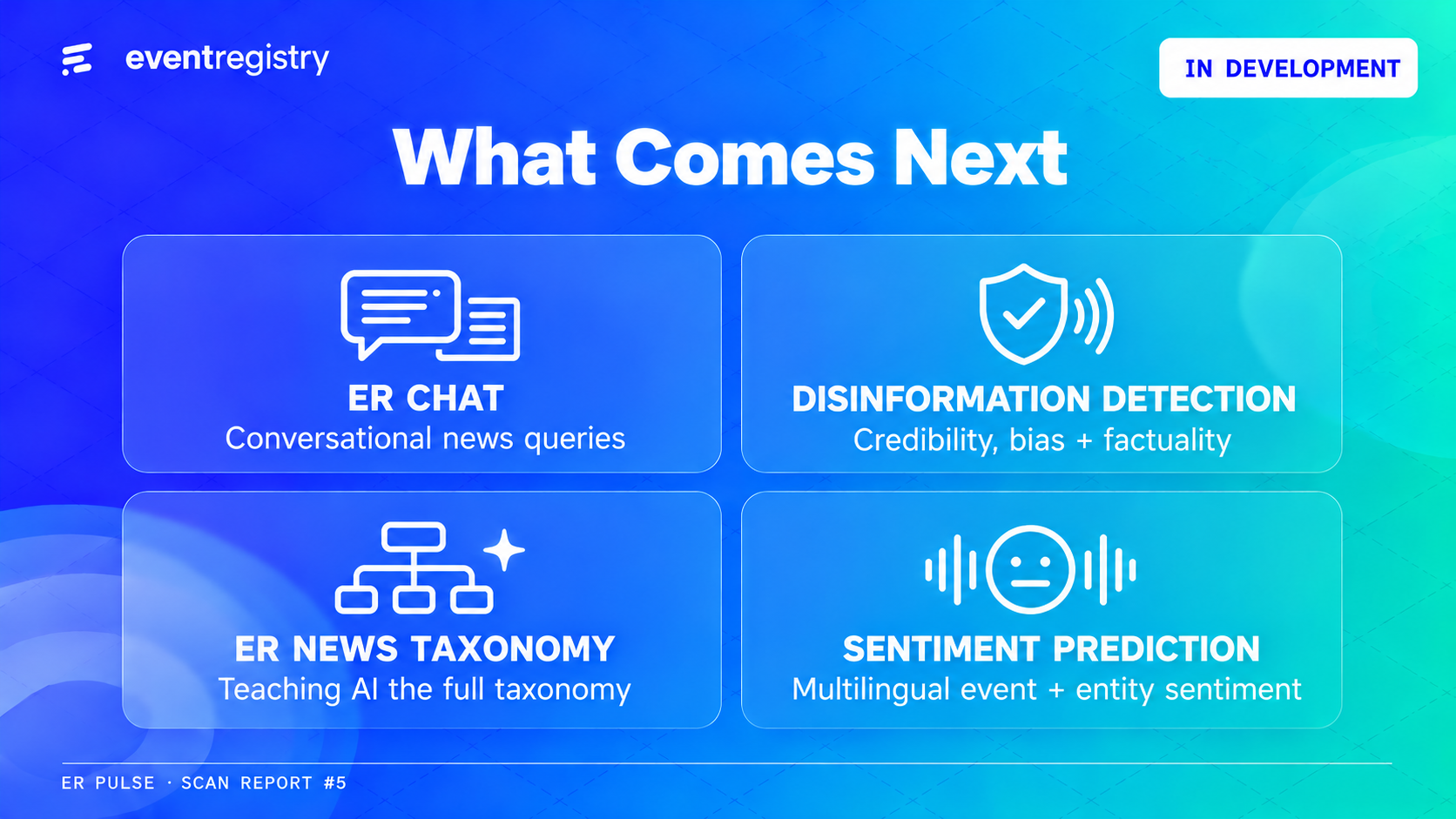
The following capabilities remain in development. They should not yet be understood as generally available features within Event Registry or NewsAPI.ai.
Credibility, Bias and Factuality Signals
We are developing disinformation-detection capabilities that combine multiple third-party source-credibility signals with political-bias and factuality classification.
This work is intended to add additional analytical signals to the news-processing pipeline. It remains an active area of development and is not yet available as a finished product capability.
Applying the Event Registry Taxonomy With AI
The structure of our proprietary Event Registry news taxonomy has now been completed across all branches.
The next stage is teaching AI models to recognise relevant concepts and apply the taxonomy consistently across languages. This moves the work from defining the taxonomy itself towards training the intelligence layer that will use it.
More Granular Multilingual Sentiment
Research is continuing into multilingual sentiment prediction at both event and entity level.
The objective is to move beyond a single sentiment score for an entire article and develop a more precise understanding of how individual organisations, people and events are represented within coverage. This research builds on the sentiment-analysis capabilities already available through NewsAPI.ai, but the more granular event- and entity-level models remain in development.
Further Event Type Improvements
Event Type extraction is already part of the processing pipeline, but its development is continuing.
Current work includes identifying and mining misclassifications, improving multilingual accuracy, adding subclassification and aspect labels, and evaluating newer models. These improvements are intended to make Event Type detection more precise across languages and across different kinds of news.
A Complete Event Registry UX Upgrade
The next evolution of the Event Registry platform goes beyond redesigning an individual page. We are working towards a more complete UX upgrade across the platform, including how users navigate, construct analyses, review information and interact with news intelligence.
AI-assisted interaction will be part of that evolution.
ER Chat is currently being evaluated in production, but it is not yet integrated into the Event Registry platform or available as a platform feature. The work ahead is focused on determining how conversational interaction and AI assistance can become a useful part of the wider Event Registry experience.
This is separate from the NewsAPI.ai MCP. The MCP connects NewsAPI.ai with external AI tools and is available now. ER Chat concerns a future interaction layer within the Event Registry platform itself.
The Next Layer Is Already Taking Shape
News never stands still—and neither can the products built to understand it.
The progress made this year gives us a stronger foundation, not a finish line. We will keep improving how Event Registry and NewsAPI.ai process information, provide context and help users work with global news.
Some improvements will be immediately visible. Others will happen deeper within the systems that power our products. We will continue testing, refining and learning from feedback as both the platform and API evolve.
The direction remains clear: greater accuracy, richer context and products that become more intuitive and useful with every iteration.
We’re still building. Still refining. Still getting better.